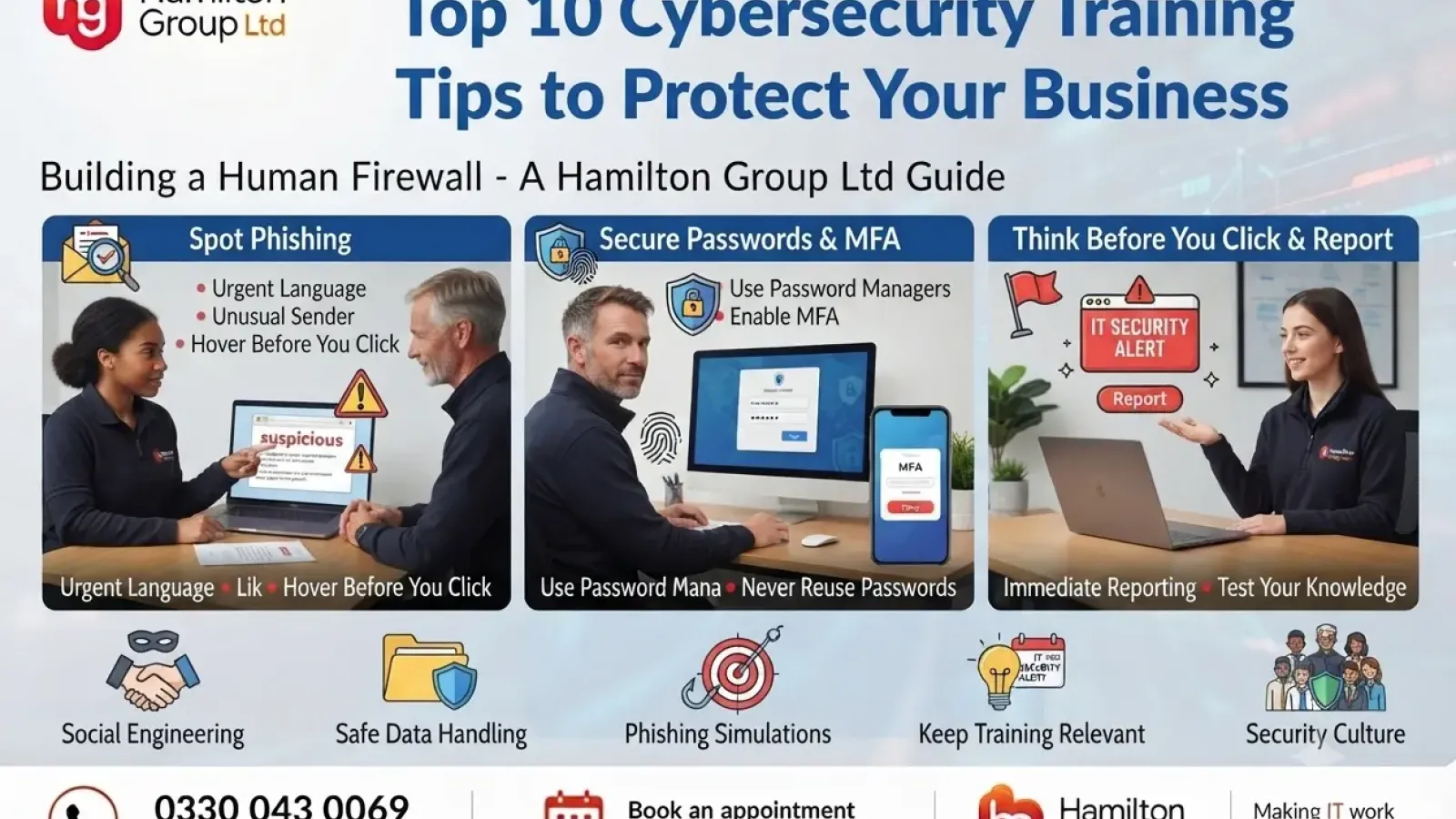
Top 10 Cybersecurity Training Tips to Protect Your Business from Attacks
Cybercriminals are becoming more sophisticated every year, but one fact remains unchanged: people are often the first line of defence.
While firewalls, antivirus software and advanced security technologies are essential, they can only do so much if employees unknowingly click on a phishing email, reuse weak passwords or share sensitive information with the wrong person.
According to industry research, human error continues to play a significant role in many cyber incidents. That’s why cybersecurity awareness training has become one of the most effective investments a business can make.
Whether your business has ten employees or a thousand, regular training helps staff recognise threats, respond correctly and build a culture where security becomes everyone’s responsibility.
Here are ten practical cybersecurity training tips that can significantly reduce your risk.
1. Teach Employees How to Spot Phishing Emails
Phishing remains one of the biggest cyber threats facing UK businesses.
Attackers create convincing emails that appear to come from:
- Microsoft
- Banks
- Delivery companies
- Customers
- Suppliers
- Directors
- HR departments
- IT support providers
Their goal is usually to steal passwords, install malware or trick someone into making a payment.
Employees should learn to recognise warning signs such as:
- Unexpected attachments
- Urgent language
- Requests to reset passwords
- Unusual sender addresses
- Poor spelling or grammar
- Links that don’t match the displayed text
- Requests for confidential information
Training staff to pause and verify suspicious emails can prevent costly attacks before they begin.
2. Make Multi-Factor Authentication Non-Negotiable
Many employees still underestimate how important Multi-Factor Authentication (MFA) is.
Cybersecurity training should explain:
- Why passwords alone aren’t enough
- How MFA works
- Different authentication methods
- Why approving unexpected MFA prompts is dangerous
- What MFA fatigue attacks look like
Staff should understand that an unexpected authentication request should always be treated as suspicious.
If they didn’t initiate the login, they shouldn’t approve it.
3. Create Strong Password Habits
Despite years of awareness campaigns, weak passwords remain common.
Training should encourage employees to:
- Use long, unique passwords
- Never reuse passwords
- Avoid personal information
- Use password managers
- Never share passwords
- Report suspected password compromise immediately
Employees should also understand why browser password storage may not always be appropriate for business-critical accounts.
4. Train Staff to Think Before They Click
Cybercriminals rely on people acting quickly.
Whether it’s opening an attachment or approving a payment request, attackers often create a false sense of urgency.
Teach employees to pause before:
- Clicking links
- Opening attachments
- Entering passwords
- Approving MFA prompts
- Downloading software
- Sharing information
- Making payments
A thirty-second pause can prevent weeks of disruption.
5. Educate Employees About Social Engineering
Not every cyber attack begins with an email.
Attackers increasingly manipulate people through:
- Telephone calls
- SMS messages
- Social media
- Fake support calls
- Impersonation
- Visitor access
- QR codes
Employees should understand that attackers often research businesses before making contact.
Training should encourage staff to verify identities rather than relying on appearances.
Simple verification procedures can stop many attacks.
6. Explain Safe Data Handling
Employees often handle large amounts of sensitive information without fully understanding its value.
Training should cover:
- Customer information
- Financial data
- HR records
- Contracts
- Personal information
- Intellectual property
- Confidential emails
Staff should know:
- Where information can be stored
- Who can access it
- How to share files securely
- When encryption should be used
- Why personal email accounts should never be used for company data
The more valuable the data, the greater the responsibility to protect it.
7. Encourage Immediate Reporting
Many cyber incidents become worse because employees are afraid to admit they may have made a mistake.
Someone who clicked a suspicious link may hesitate to report it because they’re worried about getting into trouble.
Good cybersecurity training should encourage a culture where employees report incidents immediately.
They should know how to report:
- Suspicious emails
- Lost devices
- Unexpected MFA requests
- Accidental data sharing
- Strange pop-ups
- Unusual system behaviour
- Suspected malware
- Password compromise
The sooner IT becomes aware of a problem, the faster it can be contained.
8. Run Regular Phishing Simulations
Training works best when employees can put their knowledge into practice.
Phishing simulations allow businesses to:
- Measure awareness
- Identify high-risk users
- Reinforce good habits
- Track improvement
- Target additional training
The goal isn’t to catch employees out.
It’s to help them recognise threats in a safe environment before they encounter a real attack.
Regular simulations also keep security at the front of people’s minds.
9. Keep Training Regular and Relevant
Cybersecurity is constantly evolving.
A single annual training session is rarely enough.
Instead, businesses should provide regular awareness throughout the year.
This could include:
- Monthly security tips
- Short training videos
- Phishing campaigns
- Security newsletters
- Team briefings
- Lunch-and-learn sessions
- Interactive quizzes
- Incident reviews
Short, frequent reminders are often more effective than long annual presentations.
Training should also reflect the latest threats affecting UK businesses.
10. Build a Security-First Culture
Technology alone cannot create a secure organisation.
The most resilient businesses make cybersecurity part of their everyday culture.
Employees should feel comfortable:
- Asking questions
- Reporting mistakes
- Challenging unusual requests
- Verifying payments
- Seeking advice
- Following security procedures
Managers should lead by example.
If leadership ignores security policies, employees are far less likely to take them seriously.
When everyone understands that cybersecurity is part of their role—not just IT’s responsibility—the organisation becomes significantly harder to attack.
Why Cybersecurity Training Matters
Effective security awareness training helps businesses:
- Reduce phishing attacks
- Prevent ransomware infections
- Protect Microsoft 365 accounts
- Improve password security
- Reduce accidental data loss
- Meet compliance requirements
- Support Cyber Essentials certification
- Improve cyber insurance readiness
- Reduce downtime
- Protect customer trust
The cost of training is usually far lower than the cost of recovering from a successful cyber attack.
Common Cybersecurity Training Mistakes
Many organisations invest in training but fail to achieve lasting results.
Common mistakes include:
- Delivering training only once a year
- Making sessions too technical
- Using outdated examples
- Not testing employee knowledge
- Ignoring new starters
- Failing to measure success
- Not involving senior leadership
- Treating security as an IT-only responsibility
The most effective programmes are continuous, engaging and relevant to employees’ everyday work.
What Should a Cybersecurity Awareness Programme Include?
A comprehensive training programme should cover topics such as:
- Phishing
- Password security
- Multi-Factor Authentication
- Business Email Compromise
- Social engineering
- Safe browsing
- Remote working
- Mobile device security
- Data protection
- Microsoft 365 security
- Cloud security
- Physical security
- USB devices
- Insider threats
- AI-related cyber risks
- Incident reporting
Training should be tailored to different departments where appropriate. For example, finance teams may need additional guidance on payment fraud, while HR teams should focus on protecting employee data.
How Hamilton Group Can Help
At Hamilton Group, we believe that your employees are one of your strongest cybersecurity defences.
We help UK businesses build effective security awareness programmes through:
- Cybersecurity awareness training
- Phishing simulation campaigns
- Microsoft 365 security reviews
- Multi-Factor Authentication deployment
- Email security solutions
- Endpoint Detection and Response
- Managed Cyber Security
- Vulnerability assessments
- Cyber Essentials certification support
- Backup and disaster recovery
- Incident response planning
- Managed IT Support
Our experts work with businesses to create practical training that is engaging, relevant and designed to reduce real-world cyber risk.
Turn Your Employees Into Your Strongest Defence
Cyber attacks continue to evolve, but one thing remains constant: informed employees are far less likely to become victims.
Regular cybersecurity training helps staff recognise threats, protect sensitive information and respond quickly when something doesn’t seem right.
Combined with strong technical controls such as Multi-Factor Authentication, managed endpoint protection, secure backups and proactive monitoring, security awareness forms a critical part of any modern cybersecurity strategy.
Investing in your people is one of the smartest cybersecurity decisions your business can make.
If you’d like to improve your organisation’s cybersecurity awareness or strengthen your overall cyber resilience, contact Hamilton Group on 0330 043 0069. Our experts can help you protect your business, your employees and your customers from today’s ever-evolving cyber threats.