Should Business Size Matter?
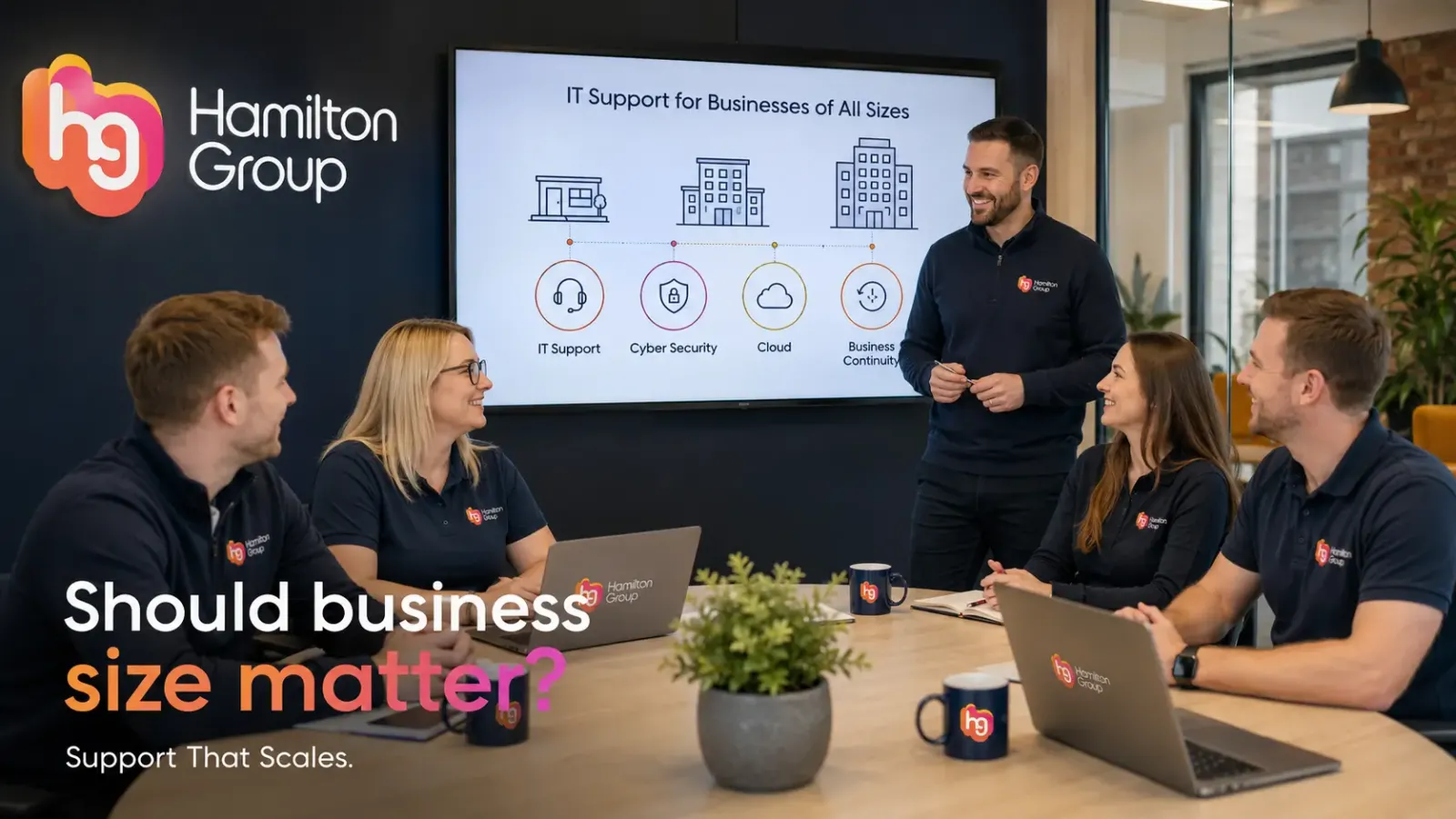
When a business contacts an IT provider, should the number of employees determine the quality of service it receives?
At Hamilton Group, we do not believe it should.
A business with ten employees may be smaller than an organisation with several hundred, but that does not make its systems, customers, deadlines or security any less important. A technical problem that affects a small team can be just as disruptive as an outage affecting a much larger company.
In some cases, the impact can be even greater.
A larger organisation may have internal IT staff, spare equipment and several people capable of covering an absent colleague. A smaller business may rely on one internet connection, one key application and a small number of employees to keep everything running.
When those systems fail, there may be no backup team waiting to take over.
Business size should influence the design and cost of an IT service, but it should not determine whether the business receives professional advice, reliable security and responsive support.
Smaller Does Not Mean Simpler
There is a common assumption that smaller businesses have straightforward IT requirements.
That is rarely true.
A small organisation may still depend on:
- Microsoft 365
- Cloud-based accounting software
- Customer relationship management systems
- Industry-specific applications
- Remote and hybrid working
- Business telephone systems
- Cybersecurity monitoring
- Data backups
- Mobile devices
- Multiple offices
- Regulatory requirements
The business may have fewer users, but those users often depend on technology for almost every part of their working day.
A ten-person professional-services firm could hold confidential client information, process large financial transactions and operate under strict regulatory obligations. A small manufacturer could depend on specialist software, network-connected machinery and remote access for suppliers.
The number of employees does not accurately measure the importance or complexity of a business’s technology.
Every Business Is a Potential Cybersecurity Target
Cybercriminals do not only attack large companies.
Smaller businesses can be attractive targets because criminals may assume they have weaker security controls, limited internal expertise and less ability to detect suspicious activity.
Automated attacks make it possible to scan thousands of organisations for exposed accounts, unpatched systems and poorly configured cloud services. The attacker may know very little about the business before attempting to compromise it.
This means a smaller business still needs appropriate protection, including:
- Multi-factor authentication
- Managed endpoint security
- Email protection
- Reliable backups
- Security patching
- User-awareness training
- Dark-web and identity monitoring
- Appropriate administrator controls
- Incident-response procedures
The solution should be proportionate to the organisation’s risk and budget, but basic protection should not be treated as optional simply because the business has fewer employees.
Downtime Can Hit Smaller Businesses Harder
When a large company loses access to a system, it may be able to move work to another office, switch to a secondary platform or use an internal support team to investigate the problem.
Smaller businesses often have fewer alternatives.
A failed internet connection may prevent employees from accessing cloud applications, processing payments or communicating with customers. A compromised Microsoft 365 account could interrupt email across the whole organisation. A failed server may stop an important line-of-business application from working.
Even a relatively simple issue can have a significant effect when several employees depend on the same system.
The cost of downtime is not only measured in lost working hours. It can also include:
- Missed customer enquiries
- Delayed projects
- Lost sales
- Damaged client confidence
- Overtime and recovery costs
- Compliance concerns
- Increased pressure on employees
- Reputational damage
This is why smaller businesses need reliable support rather than a service that treats them as a low priority.
Should Larger Customers Receive Faster Support?
An IT provider may naturally have customers of different sizes, but its support process should not be based solely on which customer pays the largest monthly invoice.
Support should be prioritised according to impact and urgency.
For example, a password reset for one employee is different from an organisation-wide email outage. A minor application question is different from a suspected cyberattack.
A professional IT provider should use clear priorities and service levels so that genuinely serious incidents are handled appropriately.
At Hamilton Group, we aim to make first contact on IT support requests within 15 minutes. This helps us understand what has happened, assess the impact and begin moving the issue towards a resolution.
Small businesses should not be left waiting simply because a larger customer has called at the same time.
Enterprise-Level Protection Does Not Have to Mean Enterprise-Level Cost
Smaller businesses sometimes assume that modern cybersecurity and cloud management tools are only available to large organisations.
That is no longer the case.
Cloud services and managed IT platforms allow smaller organisations to access many of the same technologies used by much larger businesses.
These may include:
- Advanced Microsoft 365 security
- Conditional Access
- Endpoint detection and response
- Cloud backup
- Email filtering
- Mobile-device management
- Security monitoring
- Managed firewalls
- Password management
- Vulnerability scanning
The difference is that the solution should be designed around the organisation’s actual requirements.
A business should not be forced to purchase unnecessary products, but it should also not be placed on an inadequate service because it is considered too small for proper protection.
Good IT support is about finding the right balance between risk, usability and cost.
The Service Should Grow with the Business
The right IT provider should support where the business is today while helping it prepare for where it wants to go next.
A growing company may need to:
- Add new employees
- Open another location
- Introduce remote working
- Replace an ageing server
- Move applications to the cloud
- Improve cybersecurity
- Meet customer compliance requirements
- Upgrade its telephone system
- Standardise equipment
- Improve business continuity
If the IT environment has been built without planning, each stage of growth can create further complications.
New employees may receive inconsistent equipment. User permissions may become difficult to manage. Older systems may not scale effectively. Security controls may be added reactively rather than as part of a clear strategy.
A good IT partner should help the business make decisions that support future growth without overcomplicating its current environment.
A Small Customer Should Still Receive Strategic Advice
Smaller organisations are not always able to employ a dedicated IT director or cybersecurity specialist.
That makes access to trusted advice particularly important.
An IT provider should do more than fix individual problems. It should help the customer understand:
- Which systems are reaching the end of their life
- Where security improvements are required
- Whether backups are working properly
- Which licences the business actually needs
- How technology costs may change
- What risks should be addressed first
- How IT can improve productivity
- Which projects should be planned over the next year
A small organisation may not need a full-time internal IT leader, but it still needs somebody to look at the wider picture.
Without this guidance, technology decisions are often made only when something breaks.
Personal Service Matters
As businesses grow, they may worry that they will lose the personal relationship they once had with their IT provider.
Equally, small businesses may find themselves dealing with a large support organisation where nobody seems to understand their systems or employees.
Technology support should still feel personal.
The provider should know:
- How the business operates
- Which applications are most important
- Who the key contacts are
- Which employees require additional support
- What the organisation’s priorities are
- Which changes and projects are planned
- What level of risk the business is comfortable with
This understanding allows the IT team to provide better advice and resolve problems more effectively.
A support ticket should not feel as though it has disappeared into a system with no ownership.
Price Should Be Proportionate, Not Service Quality
It is reasonable for a larger organisation to pay more because it has more users, devices, locations and systems to manage.
However, a smaller monthly fee should not mean receiving an unprofessional service.
Every customer should expect:
- Clear communication
- Honest recommendations
- Secure working practices
- Reliable documentation
- Appropriate escalation
- Regular reviews
- Responsive support
- Transparent pricing
- Proper account management
- Respect for the importance of their business
The scope of service may differ, but the standard of delivery should remain high.
There Is No Such Thing as an Unimportant User
For an IT provider, a support request may be one of many received that day.
For the employee reporting it, the problem may be preventing them from doing their job.
They may be unable to access an important document, join a customer meeting, send an invoice or complete work before a deadline.
It is important to remember the person behind the ticket.
Good support means listening carefully, communicating clearly and avoiding unnecessary technical language. Employees should feel comfortable reporting problems, including potential security incidents.
If a user is worried that they will be criticised for clicking a suspicious link or approving an unexpected sign-in request, they may delay reporting it.
That delay can turn a manageable incident into a much larger problem.
The Right Question Is Not “How Big Are You?”
Business size is relevant when designing an IT service, but it should not be the first measure of a customer’s importance.
The better questions are:
- How dependent is the business on its technology?
- What information does it need to protect?
- Which systems are critical?
- What would happen during an outage?
- Which regulations or customer requirements apply?
- What are the organisation’s growth plans?
- What level of support does the team need?
Two businesses with the same number of employees may have completely different IT requirements.
One may operate entirely from a single office using standard cloud applications. Another may work across multiple sites, process sensitive information and depend on specialist systems.
A suitable IT strategy must reflect the individual business rather than placing it into a category based only on headcount.
Every Business Deserves Reliable IT Support
Smaller businesses should not have to accept slow responses, weak cybersecurity or outdated technology.
Larger organisations should not have to sacrifice personal service as they grow.
The best IT support adapts to the size and complexity of the customer while maintaining the same commitment to quality, security and communication.
Business size should affect the scale of the solution.
It should not affect how seriously the business is taken.
How Hamilton Group Can Help
Hamilton Group supports businesses of different sizes with practical, responsive and security-focused IT services.
We take the time to understand how each organisation works, which systems matter most and where technology can help it become more secure, productive and resilient.
Our services can include:
- Managed IT support
- Microsoft 365
- Cybersecurity
- Cloud services
- Business continuity and backup
- Network and Wi-Fi management
- VoIP telephone systems
- Device management
- Security awareness training
- Cyber Essentials support
- Technology planning
- IT strategy and reviews
- Project delivery
- Ongoing monitoring
Whether your business has a small team, multiple offices or plans for significant growth, you should receive an IT service designed around your needs rather than a generic package.
At Hamilton Group, we aim to make first contact on IT support requests within 15 minutes, helping employees receive assistance quickly when technology affects their work.
Call Hamilton Group on 0330 043 0069 to discuss how we can support your business, whatever its size.